Cape Manzamo and the Onna Coast: Okinawa's Famous Cliff, Done Right
A 20-meter limestone cliff, a grassy top and the sea on three sides. What Cape Manzamo costs now, when to go for sunset, how to get there from Naha Airport and how to fit it into a half day on the Onna coast.
- Entry
- ¥100 per person, preschoolers free
- Cliff viewing
- 8:00 until sunset
- Parking
- free (315 car spaces in two lots)
- From the airport
- bus 120, about 2 hours
- Best time
- November to early May, late afternoon



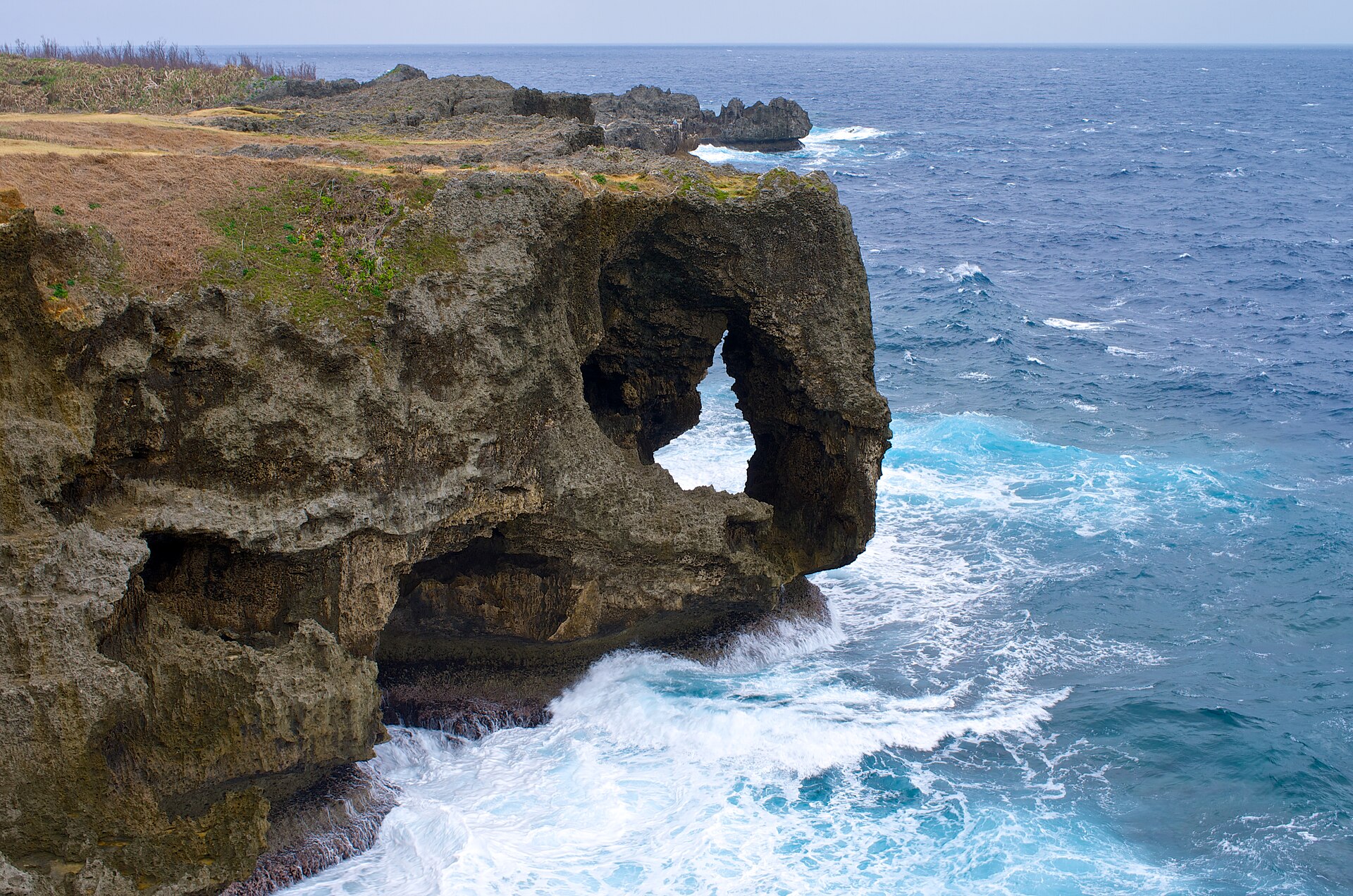
You walk out of the visitor building onto a grass park that sits on top of the cliff. Past its rocky edge, a 20-meter (about 65 ft) wall of Ryukyu limestone drops to the sea. Late in the day the sun goes down over the water, and the grass on top is where you watch it.
This is Cape Manzamo (万座毛, Manzamō) in Onna Village, on Okinawa's main island. This guide covers what it costs, when it's open, how long to stay and what to pair it with on the Onna coast.
- Guests at the Onna resorts, who are minutes away
- Drivers heading north to Motobu who want a short stop
- Sunset chasers
- Families with strollers or a wheelchair user
- ¥100Entry per person, adults and children the same
- 20 mHeight of the limestone cliff
- 315Free car spaces in the two parking lots
- ¥1,710Bus 120 from Naha Airport, about 2 hours


As of October 2026, Manzamo official site and Naha Airport bus guide
What it costs and when it's open
Since October 2, 2020, you pay a small fee to walk the cliff top. You buy the ticket at the window in the visitor building on the way in.
- Entry: ¥100 per person, the same for adults and children. Children who haven't started elementary school get in free.
- Cliff viewing: from 8:00 until sunset.
- Visitor building: 8:00–20:00 from March to October, 8:00–19:00 from November to February.
- Closed days: none, but the site may close for typhoons and other natural disasters (all as of October 2026, official site).
Winter hours don't all match. An older notice on the operator's site gives shorter hours for November and December, 8:00–18:00 (as of October 2026, official site). If you plan a late winter visit, check the current hours with the operator first.
¥100 is well under a dollar. Have some yen coins ready: the official site doesn't say whether cards are taken at the ticket window, so treat that as unconfirmed (fee as of October 2026, official site).
The "until sunset" rule matters. In winter the sun sets early, so if you arrive after work hours in December, you may find the lawn already closed even though the building is open. Check the day's sunset time for Naha on the National Astronomical Observatory of Japan's calculator (linked below) before you go.
Where the name comes from
According to the operator, Ryukyu King Sho Kei praised the grassland on top as a field big enough for ten thousand people to sit on, and the name came from that. The operator tells it as a traditional story ("it is said"), not as recorded history.
Inside the visitor building
The building you walk through to reach the cliff is the Manzamo visitor facility, run by the operator. It is worth a few minutes of its own, mostly for the free top-floor view.
- 1st floor: information desk, ticket window, coin lockers, an accessible restroom, a nursing room with a diaper table, and a viewing area.
- 2nd floor: shops and a wooden deck.
- 3rd floor: a free observation deck, with the sea and the cliff top on one side and Mt. Onna (Onna-dake) inland on the other (all as of October 2026, official site).
Strollers and wheelchairs can be borrowed for free at the 1st-floor information desk, for use in the building and on the cliff top. For food, the operator lists a food court with local restaurants, a Ryukyuan restaurant called Matsunoshita and a gift shop of Onna specialties called Zou no Hana ("the elephant's nose"). The official site doesn't give separate hours for each shop, so ask at the desk.
How long to stay

The official site doesn't give a walking route or a time for the loop, so we don't give one either. The operator describes the top as a grass park on the cliff, not a hiking trail. Plan a short stop rather than half a day here, and add time if you want to wait for the sunset.
Getting there

By car. Parking is free, in two lots (as of October 2026, official site):
- First lot: 97 cars, 13 buses, 9 motorcycles
- Second lot: 218 cars, 15 motorcycles
Japan drives on the left. With a US license, you also need an International Driving Permit issued under the 1949 Geneva Convention, according to Japan's National Police Agency. Our driving guide explains how to get one, and our airport guide covers picking up a rental car.
By bus. Route 120 runs from Naha Airport up the west coast to the Manza Beach-mae stop:
- StartDomestic Passenger Terminal stop
stop 5, 1st floor: go out of the domestic arrivals lobby; the stop is on the curb in front of it, toward the international terminal side
- Bus 120Okinawa Bus / Ryukyu Bus Kotsu (joint)about 120 min¥1,710
More about this ride
About 1 hour 50 minutes to 2 hours 20 minutes by the timetable. Route 120 also stops along the Onna coast at Renaissance Hotel-mae, Moon Beach-mae and Onna Village Office (Onna-son Yakuba-mae), so check the stop nearest your hotel.
- Get offManza Beach-mae
For reference only. Travel times depend on traffic, and routes and fares change. Check the operator's official site before you go (as of October 2026, official sites).
The operator doesn't publish walking directions from the bus stop, so check the walk on the official map link before you rely on the bus. Pay attention to the last bus back if you stay for sunset.
Pair it with the Onna coast
Cape Manzamo sits on the Manza peninsula, next to the ANA InterContinental Manza Beach Resort. Several of Okinawa's beach resorts are on this same Onna coast, so the cape fits easily into a half day here.
- Morning or midday at a beach, then the cape in the late afternoon for the light. A full guide that compares Okinawa's beaches is coming; until then, our beach resorts guide covers the Onna hotels and their beaches.
- On the way north. If you're driving to Motobu and the Churaumi Aquarium, the cape is a natural break in the drive.
- If you're staying in Onna, see Where to Stay in Okinawa for how the area compares with Naha and Chatan.
Route 120 also stops at several other points along the Onna coast. They are listed in the route box above, so you can check the stop nearest your hotel.
Who can skip it. If you've already seen big sea cliffs at home, or you only have one day and it's raining, the cape is a short view more than an experience. It is at its best in clear weather and late light.
When to go
Time of day. The operator singles out the sunset as worth seeing, so the late afternoon is the classic time. Remember that viewing ends at sunset, so arrive early enough to get your ticket and walk out.
Time of year. The cape is a year-round stop, but the weather changes what you see.
- Typhoons: the Okinawa region sees the most typhoon approaches from July to September, peaking in August, and the site may close for them. On average 7.7 typhoons a year come near Okinawa (Japan Meteorological Agency normals). Follow the Japan Meteorological Agency's warnings, not forecasts from elsewhere.
- Rainy season: around May 10 to around June 21 in an average year.
- Heat: Naha's average high is about 32°C (89°F) in July and August, so bring a hat and water.
- Mild months: November to early May has the fewest typhoon approaches, with average highs of about 20–27°C (68–81°F).
| Jan | Feb | Mar | Apr | May | Jun | Jul | Aug | Sep | Oct | Nov | Dec | |
|---|---|---|---|---|---|---|---|---|---|---|---|---|
| Avg high | 68°20°C | 68°20°C | 71°22°C | 76°24°C | 81°27°C | 86°30°C | 89°32°C | 89°32°C | 87°31°C | 83°28°C | 77°25°C | 71°22°C |
| Avg low | 59°15°C | 59°15°C | 62°17°C | 66°19°C | 72°22°C | 77°25°C | 81°27°C | 80°27°C | 78°26°C | 74°24°C | 69°20°C | 62°17°C |
| Rain | 4.0"102mm | 4.5"114mm | 5.6"143mm | 6.3"161mm | 9.7"245mm | 11.2"284mm | 7.4"188mm | 9.4"240mm | 10.8"275mm | 7.1"179mm | 4.7"119mm | 4.3"110mm |
| Typhoons | – | – | – | – | 0.4 | 0.6 | 1.5 | 2.2 | 1.9 | 1.1 | 0.3 | – |
| Rainy season | ● | ● | ||||||||||
| Box jellyfish | ● | ● | ● | ● | ||||||||
| Golden Kings | ● | ● | ● | ● | ● | ● | ● | ● |
- Typhoons: about 7.7 a year come near Okinawa, most in August and September. Flights and ferries can stop for a day or two — keep your plans flexible in late summer.
- Rainy season: around May 10 to around June 21 in a typical year.
- Swimming: Swim at managed beaches during their swimming season, when lifeguards keep watch and nets are set against box jellyfish. Many beaches have neither. Check the beach's official page before you go.
- Box jellyfish: advisory June 1 – September 30 (2026); most stings in July and August; swim inside the nets and cover your legs.
- Basketball: B.LEAGUE season runs fall to spring, with playoffs in May.
- The nonstop: United's SFO–Naha nonstop starts March 27, 2027, three times a week. Some reports say it is seasonal; that is not confirmed yet.
Climate: Japan Meteorological Agency, Naha climate normals 1991–2020. Typhoons: JMA normals. Jellyfish: Okinawa Prefecture, box jellyfish advisory. Checked 2026-10-10.
Official info

- Cape Manzamo operator (Manzamo Co., Ltd.): manzamo.jp (Japanese only)
- Visitor facility, hours and parking: manzamo.jp/manzamou.php (Japanese)
- Official Instagram: @manzamo_inc
- Official X: @manzamo_inc
- Sunset times for Naha: National Astronomical Observatory of Japan (Japanese)
Planning the whole trip? The 5-day Okinawa itinerary from SFO shows how a stop like this fits into a short trip.
Sources
- Manzamo Co., Ltd. — Cape Manzamo (official, Japanese)
- Manzamo Co., Ltd. — Manzamo visitor facility: hours, floors, parking (official, Japanese)
- National Astronomical Observatory of Japan — sunrise and sunset times by prefecture (Japanese)
- Naha Airport Terminal — bus guide
- Japan Meteorological Agency — Naha climate normals (Japanese)
- Japan Meteorological Agency — typhoon normals (Japanese)
- Japan Meteorological Agency — rainy season normals (Japanese)
- National Police Agency — International driving permits Q&A
Corrections and updates
- 2026-10-20 — Added the operator's older, shorter winter hours (8:00–18:00 in November and December) and a source for the International Driving Permit rule
- reworded the cliff-top description to match the official site